

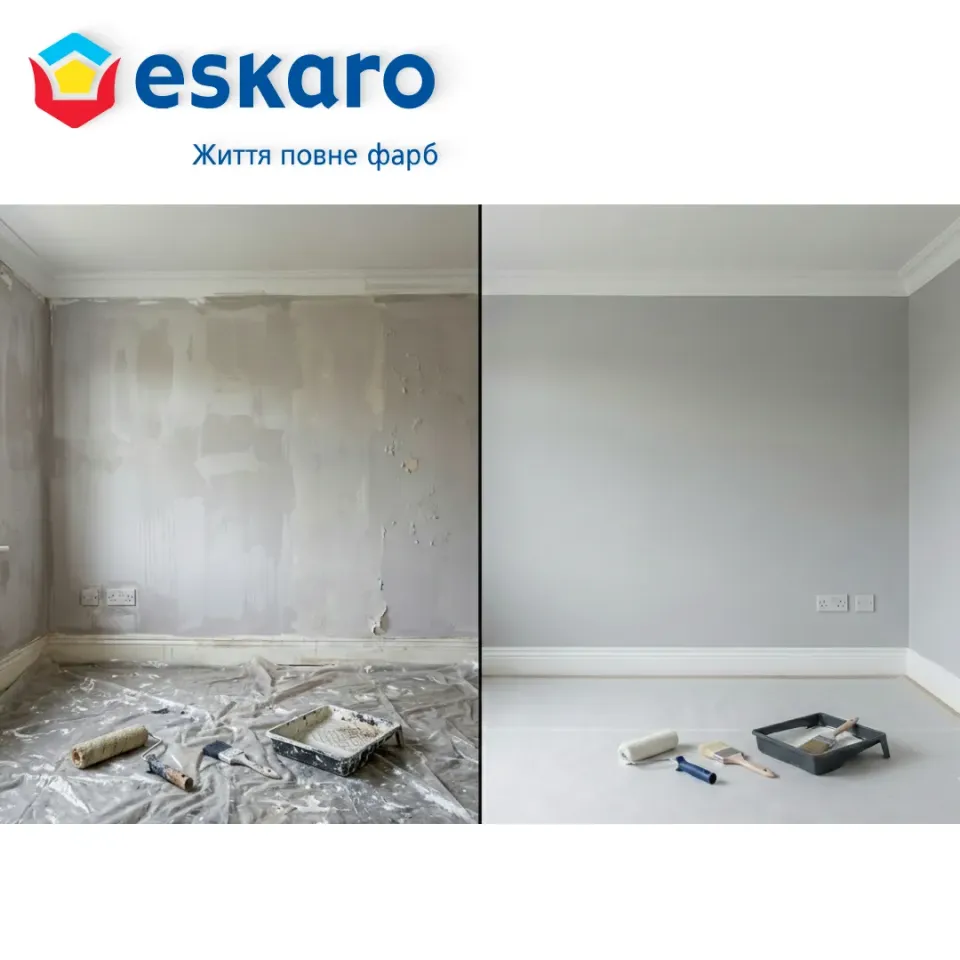
Coloring mistakes: how to get the perfect result
Painting mistakes occur in both beginners and experienced craftsmen. Improper surface preparation, choosing the wrong coating or violation of the application technology lead to the fact that the fresh finish can lose its aesthetic appearance after just a few months. Most often, various types of coating defects occur, such as: cracks, peeling.
In this article, we will analyze in detail the most common mistakes, explain the reasons for their occurrence and show how to avoid them. You will learn how to properly paint different types of surfaces, and also get tips on which products from the eskaroshop.com.ua catalog will help you get a professional result with delivery throughout Ukraine.
The most common mistakes when painting
1. Insufficient surface preparation
Description: The master is in a hurry to start painting without cleaning and leveling the wall.
Reasons: The desire to save time, underestimating the importance of the preparatory stage.
Consequences: The paint does not hold well, stains appear, irregularities and peeling appear.
How to avoid:
• Clean the surface from dust, grease, old paint
• Fill cracks with high-quality putty
• Sand the surface with fine-grained sandpaper (P120–P180)
• Prime with a primer that suits your type of base and finish.
2. Lack of priming
Description: Applying paint directly to an unprepared surface.
Reasons: Saving on materials, ignorance of technology.
Consequences: Poor adhesion, uneven paint absorption, excessive material consumption, rapid peeling, the appearance of spots and streaks when painting.
How to avoid:
• Always apply 1–2 coats of primer (according to the manufacturer's recommendations).
• For porous surfaces (drywall, plaster) use deep-penetrating compounds
• Choose a primer that is suitable for your surface type and finish.
• Drying time of the primer - at least 4–6 hours at +20°C
Recommended products: Acrylic primers, dilution concentrates, specialized compounds for wood/metal.
3. Bad tools
Description: Old rollers or with uneven pile, from which bristles stick out, or an unsuitable type of brush.
Reasons: Saving on tools.
Consequences: Visible marks, fluff and shagreen formation on the paint, uneven application.
How to avoid:
• Buy quality painting tools: rollers, telescopic handles, brushes for the appropriate type of material or type of work.
• Before use, soak the roller in water and squeeze well to remove excess moisture
For water-soluble paints, use brushes with synthetic bristles.And for organic-soluble paints, use brushes with natural bristles.
4. Refusal to use masking tape
Description: Trying to draw clear lines between colors "by hand" or when painting adjacent parts of surfaces.
Reasons: Confidence in one's own skill, saving time.
Consequences: Uneven edges, stains on adjacent surfaces, the need for adjacent parts of surfaces.
How to avoid:
• Always use high-quality, suitable masking tape for the type of work
• Apply the tape to a clean, dry surface.
Remove the tape at a 45° angle before the last coat of finish has dried.
5. Painting on a damp surface
Description: Applying paint to wet plaster, primer or previous coat.
Reasons: Want to save time.
Consequences: Blistering, peeling, stains, long drying times.
How to avoid:
• Check the wall moisture content with a moisture meter (<4% for most paints)
• Follow the drying time between coats (indicated on the label)
In humid weather, increase the pauses between stages by 30–50%.
Step-by-step instructions: how to paint a surface without mistakes
Following this sequence guarantees a result like a professional.
1. Cleaning and preparation: Remove old wallpaper or peeling paint. Wash the walls from grease, dirt and dust.
2. Puttying: Level out potholes and fill cracks. Use a putty that is suitable for the specific type of finish of the room (dry or wet).
3. Sanding: After the putty dries, go over it with sandpaper of the appropriate grain.
4. Priming: Apply one or two coats of primer, according to the manufacturer's recommendation, to even out the absorbency of the surface.
5. Protection: Tape off baseboards, sockets, ceiling moldings and adjacent surfaces that need to be protected from paint.
6. Painting corners: Start painting from corners, adjacent surfaces and hard-to-reach places using a brush or small roller.
7. Basic painting: For interiors, use a roller (10–12 mm pile for walls, and 12–15 for painting ceilings). Apply the paint in W-shaped movements, and do not allow gaps.
8. Drying: Let the first layer dry for at least 2–4 hours at a temperature of +18+22°C and a humidity of no more than 65%.
9. Second layer: Apply a finishing layer for ideal color depth.
Tips for correcting mistakes already made
Bubbles and blisters
1. Remove the old coating (sand the paint layer completely or partially).
2. Remove dust.
3. Fill the necessary areas of the surface or carry out a continuous filling.
4. Sand the putty surface.
5. Remove dust.
6. Prime.
7. Paint.
Visible streaks and roller marks
1. Sand the surface with fine-grained sandpaper P220 - 280
2. Remove dust with a damp cloth
3. Allow the surface to dry.
4. Apply 1-2 coats of paint evenly using a quality tool.
Cracks in the paint
If there are cracks in the paintwork:
Remove the old paintwork to the base, prime, apply primer, apply topcoat.
If there are cracks on the base:
Scrape, clean, prime, putty, sand, re-prime, paint.
Poor adhesion (paint is peeling)
1. Remove all peeling paint with a spatula
2. Clean the surface to a solid base
3. Prime with an adhesive primer
4. Fill if necessary.
5. Sand with sandpaper of the appropriate grain size.
6. Remove dust and prime the surface.
7. Apply paint in 2–3 thin layers
Uneven color
1. Use paint from one batch, or mix the required amount of tinted paint from different batches in one container
2. Apply a layer of paint to the entire surface (not locally)
3. Use the "wet-on-wet" technique for uniformity
Conclusion
It is quite possible to avoid mistakes when painting - it is enough to follow the technology, use high-quality materials and tools, and also not to rush. Tip: out of 100 percent of the time allocated for finishing work, 75% of the time should be allocated to preparing the base for finishing. Proper surface preparation, priming, selection of the appropriate paint and careful application guarantee you a flawless result that will last for years.
Need advice?
Visit our store eskaroshop.com.ua or branded stores in your city, where you will find everything you need: from professional putties to premium paints. Our consultants will help you choose the perfect composition for your project!