
Waterproofing and waterproofing tape: How to protect your home from moisture
Moisture is one of the main enemies of any building structure. It gradually destroys concrete, brick and plaster, provokes the appearance of mold and cracks. Waterproofing solves this problem: it creates a continuous seamless coating that does not let water through, regardless of its source - whether it is splashes in the shower, or precipitation on the terrace, or groundwater near the foundation.
In this article, we will consider the main types of waterproofing materials, their technical characteristics and selection rules for a specific task.
Waterproofing materials are divided into several main types depending on the principle of action and method of application: film (roll and membrane), coating (mastic), injection and permeable. Each of these options has its own application features, advantages and limitations. In this article, we will focus in detail on coating waterproofing materials, as one of the most convenient and common solutions in private and professional construction.
Some options for coating waterproofing
All coating waterproofings are divided into several types depending on the composition and scope of application.
Acrylic water-dispersion mastics
The most common option for interior work. The basis is a dispersion of acrylic copolymer. After drying, an elastic rough film is formed that does not let water through and at the same time provides good adhesion of tile adhesive. Such mastics are non-toxic, odorless and are diluted with water. Suitable for bathrooms, showers, toilets and kitchens under tile cladding. This group includes materials Aquastop Hydro and Grover MW 301.
Two-component waterproofing
This is a separate class of materials with increased reliability. Unlike single-component ones, such mastics contain a second active component - powder modified cement, which is mixed with a liquid acrylic base immediately before application. Thanks to this, the finished coating acquires significantly higher strength and wear resistance: it is able to withstand constant hydrostatic water pressure, which acts not only on the bottom, but also on the walls of the structure (for example, in pools or tanks). That is why two-component waterproofing is the optimal solution for objects where water acts continuously and under pressure.
In our assortment, this class is represented by the Eskaro Aquastop Hydro 2K material. It consists of liquid acrylic component A and powder component B, which are mixed in a ratio of 1:3 by weight. The finished solution must be used within 60 minutes. The coating withstands water pressure up to 0.7 MPa, is resistant to chlorinated water and ultraviolet, does not cause corrosion of steel. Withstands cracking of the base up to 2.5 mm at temperatures up to −20 °C. It is used for swimming pools, drinking water tanks, fountains, artificial reservoirs, external walls of basements and foundations, balconies and terraces. Tiles can be glued 24 hours after applying the last layer.
Bitumen-rubber mastics
These materials based on modified bitumen are intended primarily for outdoor work. They are resistant to weathering, temperature fluctuations and provide reliable seamless waterproofing on complex surfaces. Depending on the composition, such mastics are SBS-modified (with increased elasticity) or with the addition of synthetic polymers that improve adhesion and durability of the coating.
Our assortment includes two products from this group. Grover Dysperbit DB+ is a water-dispersion SBS-modified mastic for flat roofs and seamless roofing. The material is applied to wet surfaces and becomes resistant to precipitation in just 5 hours. It withstands cracking of the base up to 1 mm at temperatures up to −25 °C and does not melt even at temperatures of +100 °C. It is used for seamless roofing with fiberglass reinforcement and for the restoration of old roll coatings. The second product - Grover Dysperbit - is designed specifically for waterproofing the basement and underground parts of buildings, where protection against groundwater and capillary moisture is required. Inside residential premises with constant occupancy, materials of this group are not used.
Why is a reinforcing tape for waterproofing needed:
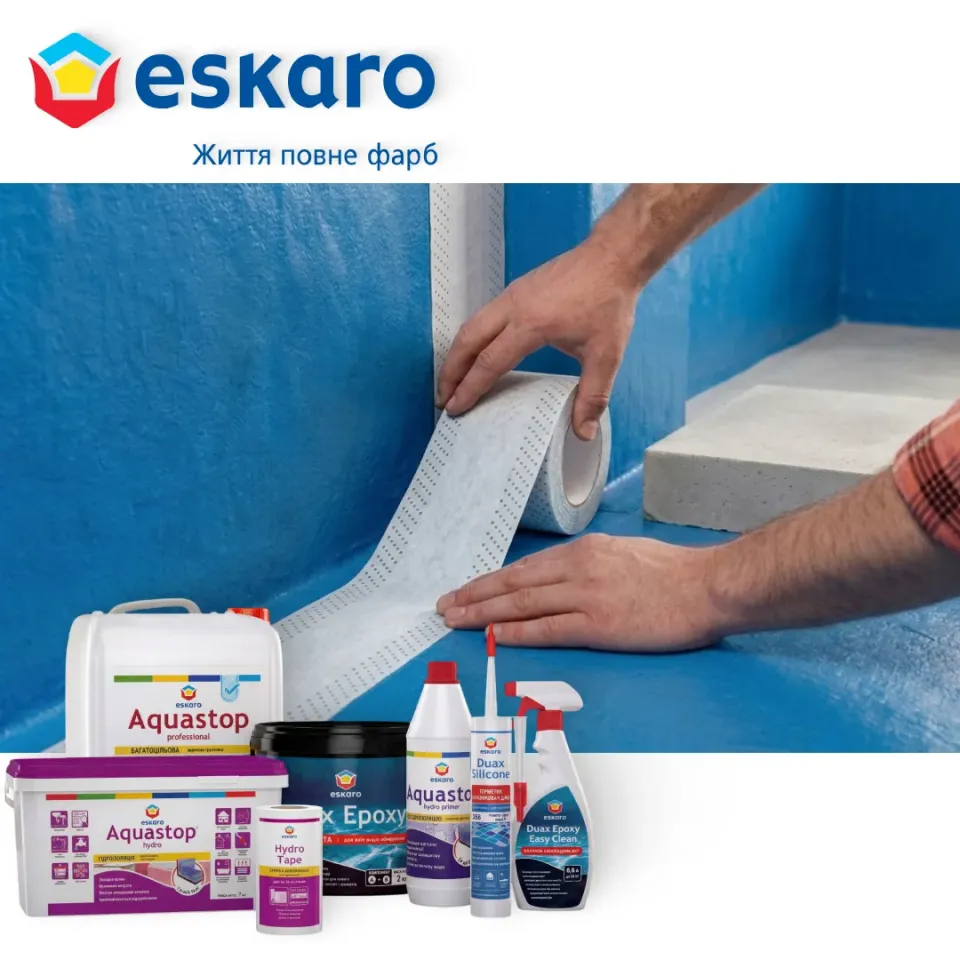
A reinforcing tape is an essential part of any properly performed waterproofing. It is embedded in a fresh layer of mastic and strengthens the most vulnerable areas: internal corners, joints between slabs, joints of surfaces made of different materials, areas around plumbing fixtures and floor drains.
Without a tape, even high-quality mastic in the corners becomes covered with microcracks over time due to temperature deformations of the structure.
Our assortment includes the Eskaro Hydro Tape line in several versions. Standard reinforcing tape in rolls of 25 meters is designed for corners and joints under conventional coating waterproofing. Hydro Tape 2K waterproofing tape is available in rolls of 10 and 50 meters. It is designed specifically for use with two-component materials to protect critical junctions.
The technology for laying the tape is the same for all options: the tape is laid in a fresh layer of mastic and pressed tightly with a plastic or rubber spatula so that it is completely saturated with the material. After drying, an additional layer of waterproofing is applied on top. The tape is always embedded in two layers of mastic - this is a prerequisite for a reliable connection.
How to choose the right material
The choice depends on the specific task.
Bathroom, shower, toilet, kitchen - under tiles
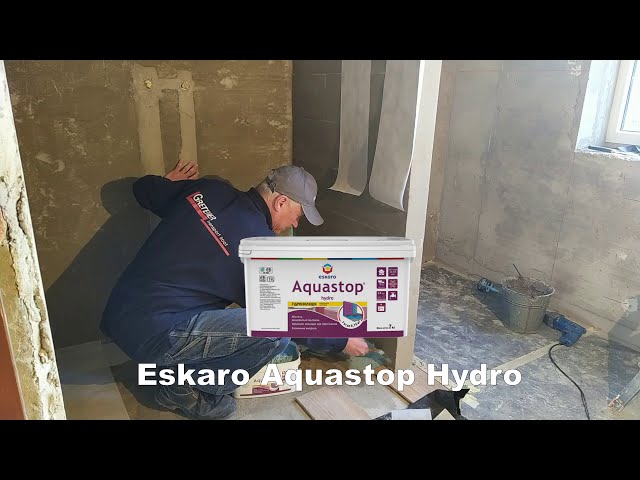
Any of the acrylic mastics will do: Aquastop Hydro or Grover MW 301. Be sure to use the Eskaro Hydro Tape reinforcing tape in corners, seams and around stairs. For non-standard or highly absorbent bases (drywall, aerated concrete) apply the Eskaro Aquastop Hydro Primer or Aquastop Strong adhesive primer before mastic. What the complete process of waterproofing a bathroom looks like in practice — watch the video "Waterproofing a bathroom with Eskaro Aquastop Hydro."
Pool, fountain, water tank, foundation from groundwater
Only Aquastop Hydro 2K. This is the only material in this category that can withstand constant water pressure and external loads. Use together with Eskaro Hydro Tape 2K in junctions. For non-standard or highly absorbent substrates, first apply Eskaro Aquastop Hydro Primer or Aquastop Strong.
Flat roof, restoration of old coating
Grover Dysperbit DB+. Applied with fiberglass reinforcement, in two layers. If the substrate is prone to mold or algae, additionally treat it with the biocide Biotol before applying the mastic.
Basement, underground parts of the building
Grover Dysperbit - for protection against groundwater and capillary moisture. If there is biological contamination of the surface, it is recommended to treat it with Biotol before applying.
Conclusion
Waterproofing is not the stage of repair where you should save money or rush. An error in the choice of material or a violation of the application technology does not appear immediately: water finds a way gradually, and when the problem becomes obvious, it is no longer possible to eliminate it without dismantling the base.
The main thing to remember: acrylic mastics do an excellent job in the bathroom and kitchen, but are not intended for swimming pools and basements. For serious water loads - only the two-component Aquastop Hydro 2K. For the roof - bitumen-rubber Dysperbit DB+. For the base - Dysperbit. And in each of these cases, the reinforcing tape in the corners and seams is a mandatory, not a desirable detail.
If you choose the material correctly, prepare the base according to the instructions and do not neglect the reinforcement of the nodes - the waterproofing system will last as long as the cladding itself, without leaks.
With Eskaro waterproofing materials, you create a reliable barrier against moisture.
Waterproofing and Waterproofing Tape: How to Protect Your Home from Moisture
Moisture is one of the primary enemies of any building structure
In this article, we will examine the main types of waterproofing materials, their technical characteristics, and the rules for choosing them for a specific task
Some Options for Coating Waterproofing
All coating waterproofings are divided into several types depending on their composition and scope of application
Acrylic Water-Dispersion Mastics
The most common option for interior work
Two-Component Waterproofing
This is a separate class of materials with increased reliability
In our assortment, this class is represented by the material Eskaro Aquastop Hydro 2K
It is used for swimming pools, drinking water reservoirs, fountains, artificial ponds, exterior walls of basements and foundations, balconies, and terraces
Bitumen-Rubber Mastics
These are materials based on modified bitumen intended primarily for outdoor work
Two products of this group are presented in our assortment
Why Reinforcing Tape is Needed for Waterproofing
Reinforcing tape is an obligatory part of any correctly executed waterproofing
In our assortment, the Eskaro Hydro Tape line is presented in several versions
The installation technology for the tape is the same for all versions: the tape is laid into a fresh layer of mastic and pressed firmly with a plastic or rubber spatula so that it is completely saturated with the material
How to Choose the Required Material
The choice depends on the specific task
Bathroom, shower, toilet, kitchen — under tile
Any of the acrylic mastics will work: Aquastop Hydro or Grover MW 301
Swimming pool, fountain, water reservoir, foundation against groundwater
Exclusively Aquastop Hydro 2K
Flat roof, restoration of old coating
Grover Dysperbit DB+
Plinth, underground parts of the building
Grover Dysperbit — for protection against groundwater and capillary moisture
Conclusion
Waterproofing is not the stage of renovation where it is worth saving money or rushing
The main thing to remember: acrylic mastics handle bathrooms and kitchens perfectly but are not intended for swimming pools and basements
If the material is selected correctly, the substrate is prepared according to the instructions, and the reinforcement of the nodes is not neglected — the waterproofing system will last as long as the cladding itself, without leaks
Waterproofing and Waterproofing Tape: How to Protect Your Home from Moisture
Moisture is one of the primary enemies of any building structure
In this article, we will examine the main types of waterproofing materials, their technical characteristics, and the rules for choosing them for a specific task
Some Options for Coating Waterproofing
All coating waterproofings are divided into several types depending on their composition and scope of application
Acrylic Water-Dispersion Mastics
The most common option for interior work
Two-Component Waterproofing
This is a separate class of materials with increased reliability
In our assortment, this class is represented by the material Eskaro Aquastop Hydro 2K
It is used for swimming pools, drinking water reservoirs, fountains, artificial ponds, exterior walls of basements and foundations, balconies, and terraces
Bitumen-Rubber Mastics
These are materials based on modified bitumen intended primarily for outdoor work
Two products of this group are presented in our assortment
Why Reinforcing Tape is Needed for Waterproofing
Reinforcing tape is an obligatory part of any correctly executed waterproofing
In our assortment, the Eskaro Hydro Tape line is presented in several versions
The installation technology for the tape is the same for all versions: the tape is laid into a fresh layer of mastic and pressed firmly with a plastic or rubber spatula so that it is completely saturated with the material
How to Choose the Required Material
The choice depends on the specific task
Bathroom, shower, toilet, kitchen — under tile
Any of the acrylic mastics will work: Aquastop Hydro or Grover MW 301
Swimming pool, fountain, water reservoir, foundation against groundwater
Exclusively Aquastop Hydro 2K
Flat roof, restoration of old coating
Grover Dysperbit DB+
Plinth, underground parts of the building
Grover Dysperbit — for protection against groundwater and capillary moisture
Conclusion
Waterproofing is not the stage of renovation where it is worth saving money or rushing
The main thing to remember: acrylic mastics handle bathrooms and kitchens perfectly but are not intended for swimming pools and basements
If the material is selected correctly, the substrate is prepared according to the instructions, and the reinforcement of the nodes is not neglected — the waterproofing system will last as long as the cladding itself, without leaks
Waterproofing and Waterproofing Tape: How to Protect Your Home from Moisture
Moisture is one of the primary enemies of any building structure
In this article, we will examine the main types of waterproofing materials, their technical characteristics, and the rules for choosing them for a specific task
Some Options for Coating Waterproofing
All coating waterproofings are divided into several types depending on their composition and scope of application
Acrylic Water-Dispersion Mastics
The most common option for interior work
Two-Component Waterproofing
This is a separate class of materials with increased reliability
In our assortment, this class is represented by the material Eskaro Aquastop Hydro 2K
It is used for swimming pools, drinking water reservoirs, fountains, artificial ponds, exterior walls of basements and foundations, balconies, and terraces
Bitumen-Rubber Mastics
These are materials based on modified bitumen intended primarily for outdoor work
Two products of this group are presented in our assortment
Why Reinforcing Tape is Needed for Waterproofing
Reinforcing tape is an obligatory part of any correctly executed waterproofing
In our assortment, the Eskaro Hydro Tape line is presented in several versions
The installation technology for the tape is the same for all versions: the tape is laid into a fresh layer of mastic and pressed firmly with a plastic or rubber spatula so that it is completely saturated with the material
How to Choose the Required Material
The choice depends on the specific task
Bathroom, shower, toilet, kitchen — under tile
Any of the acrylic mastics will work: Aquastop Hydro or Grover MW 301
Swimming pool, fountain, water reservoir, foundation against groundwater
Exclusively Aquastop Hydro 2K
Flat roof, restoration of old coating
Grover Dysperbit DB+
Plinth, underground parts of the building
Grover Dysperbit — for protection against groundwater and capillary moisture
Conclusion
Waterproofing is not the stage of renovation where it is worth saving money or rushing
The main thing to remember: acrylic mastics handle bathrooms and kitchens perfectly but are not intended for swimming pools and basements
If the material is selected correctly, the substrate is prepared according to the instructions, and the reinforcement of the nodes is not neglected — the waterproofing system will last as long as the cladding itself, without leaks
Waterproofing and Waterproofing Tape: How to Protect Your Home from Moisture
Moisture is one of the primary enemies of any building structure
In this article, we will examine the main types of waterproofing materials, their technical characteristics, and the rules for choosing them for a specific task
Some Options for Coating Waterproofing
All coating waterproofings are divided into several types depending on their composition and scope of application
Acrylic Water-Dispersion Mastics
The most common option for interior work
Two-Component Waterproofing
This is a separate class of materials with increased reliability
In our assortment, this class is represented by the material Eskaro Aquastop Hydro 2K
It is used for swimming pools, drinking water reservoirs, fountains, artificial ponds, exterior walls of basements and foundations, balconies, and terraces
Bitumen-Rubber Mastics
These are materials based on modified bitumen intended primarily for outdoor work
Two products of this group are presented in our assortment
Why Reinforcing Tape is Needed for Waterproofing
Reinforcing tape is an obligatory part of any correctly executed waterproofing
In our assortment, the Eskaro Hydro Tape line is presented in several versions
The installation technology for the tape is the same for all versions: the tape is laid into a fresh layer of mastic and pressed firmly with a plastic or rubber spatula so that it is completely saturated with the material
How to Choose the Required Material
The choice depends on the specific task
Bathroom, shower, toilet, kitchen — under tile
Any of the acrylic mastics will work: Aquastop Hydro or Grover MW 301
Swimming pool, fountain, water reservoir, foundation against groundwater
Exclusively Aquastop Hydro 2K
Flat roof, restoration of old coating
Grover Dysperbit DB+
Plinth, underground parts of the building
Grover Dysperbit — for protection against groundwater and capillary moisture
Conclusion
Waterproofing is not the stage of renovation where it is worth saving money or rushing
The main thing to remember: acrylic mastics handle bathrooms and kitchens perfectly but are not intended for swimming pools and basements
If the material is selected correctly, the substrate is prepared according to the instructions, and the reinforcement of the nodes is not neglected — the waterproofing system will last as long as the cladding itself, without leaks
Waterproofing and Waterproofing Tape: How to Protect Your Home from Moisture
Moisture is one of the primary enemies of any building structure
In this article, we will examine the main types of waterproofing materials, their technical characteristics, and the rules for choosing them for a specific task
Some Options for Coating Waterproofing
All coating waterproofings are divided into several types depending on their composition and scope of application
Acrylic Water-Dispersion Mastics
The most common option for interior work
Two-Component Waterproofing
This is a separate class of materials with increased reliability
In our assortment, this class is represented by the material Eskaro Aquastop Hydro 2K
It is used for swimming pools, drinking water reservoirs, fountains, artificial ponds, exterior walls of basements and foundations, balconies, and terraces
Bitumen-Rubber Mastics
These are materials based on modified bitumen intended primarily for outdoor work
Two products of this group are presented in our assortment
Why Reinforcing Tape is Needed for Waterproofing
Reinforcing tape is an obligatory part of any correctly executed waterproofing
In our assortment, the Eskaro Hydro Tape line is presented in several versions
The installation technology for the tape is the same for all versions: the tape is laid into a fresh layer of mastic and pressed firmly with a plastic or rubber spatula so that it is completely saturated with the material
How to Choose the Required Material
The choice depends on the specific task
Bathroom, shower, toilet, kitchen — under tile
Any of the acrylic mastics will work: Aquastop Hydro or Grover MW 301
Swimming pool, fountain, water reservoir, foundation against groundwater
Exclusively Aquastop Hydro 2K
Flat roof, restoration of old coating
Grover Dysperbit DB+
Plinth, underground parts of the building
Grover Dysperbit — for protection against groundwater and capillary moisture
Conclusion
Waterproofing is not the stage of renovation where it is worth saving money or rushing
The main thing to remember: acrylic mastics handle bathrooms and kitchens perfectly but are not intended for swimming pools and basements
If the material is selected correctly, the substrate is prepared according to the instructions, and the reinforcement of the nodes is not neglected — the waterproofing system will last as long as the cladding itself, without leaks