
Numbers on paint cans: how not to make a mistake with the choice
Choosing paint by color is only part of the success. It often happens that you choose a beautiful shade, and after drying you notice that the shade is not the right one. The fact is that the degree of gloss affects the visual perception of the color: the higher the gloss, the richer it seems. In addition, all the flaws of the walls are noticeable or even light dirt cannot be cleaned. The reason is ignoring the technical indicators.
1. Wet scrubbing resistance class: can your walls be washed?
This is a key indicator of the wear resistance of interior paint according to the European standard EN 13300.
It determines how resistant the coating is to wet cleaning after complete drying.
The classification is based on the thickness of the layer that is removed after 200 rubbing cycles (for classes 1–3).
Class 1 — the highest resistance
Layer loss ≤ 5 μm after 200 cycles.
✔ Heavy-duty cleaning possible
✔ Mild detergents can be used
✔ Suitable for high-traffic areas
Ideal for kitchens, hallways, children's rooms, commercial spaces.
Class 2 - high resistance
Layer loss > 5 μm and ≤ 20 μm after 200 cycles.
✔ Withstands regular wet cleaning
✔ Resistant to household dirt
A universal choice for living rooms and residential areas.
Class 3 - medium resistance
Layer loss > 20 μm and ≤ 70 μm after 200 cycles.
✔ Gentle wet cleaning possible
✔ Not recommended for heavy-duty cleaning
Suitable for bedrooms and rooms with moderate traffic.
Class 4 - low resistance
Visible damage to the coating after 40 abrasion cycles.
Only for dry rooms with minimal traffic.
Class 5 - very low resistance
After 40 cycles of abrasion, significant destruction of the layer.
Recommended only for ceilings or technical rooms without contact with moisture.
Important
✔ The abrasion class is determined in the laboratory.
✔ After painting, the surface gains full resistance in approximately 3–4 weeks.
2. Gloss level: from deep matte to glossy. What does the number in the name of the paint mean?
Gloss affects not only the appearance of the coating, but also its practicality and visual perception of color.
Previously, there was a rule: the higher the gloss level, the stronger and more resistant to washing the paint. At the same time, glossy surfaces emphasized irregularities and defects of the walls more strongly due to the reflection of light.
Modern production technologies have significantly changed the situation. Thanks to new binders, polymer additives and improved formulations, even matte and deep-matt paints can now have a high wet-scratch resistance class and good wear resistance.
Therefore, the gloss level is no longer a direct indicator of the strength of the coating - it should be evaluated together with the abrasion class and technical characteristics of the product.
| Тип блиску | Показник (GU) |
|---|---|
| Глибокоматова | 0–5 |
| Матова | 6–10 |
| (Напівматова) | 11–25 |
| Напівглянсова | 26–60 |
| Глянсова | 60 та вище |
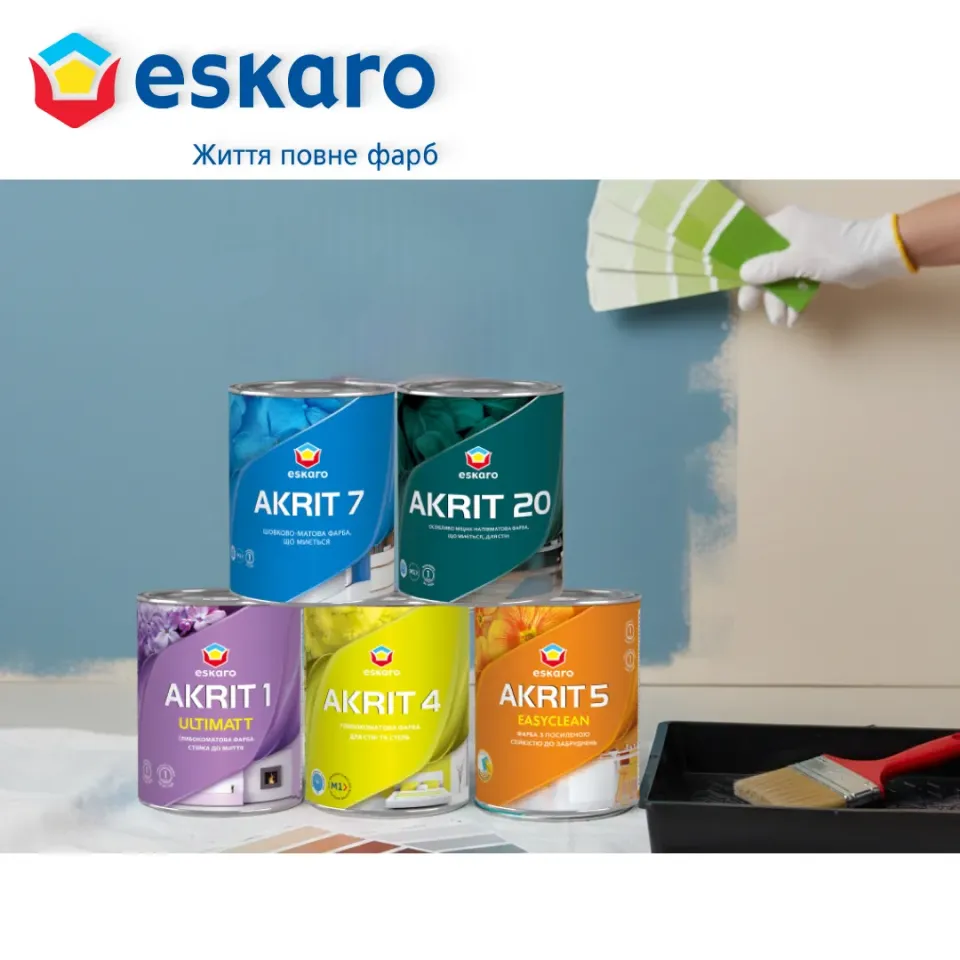
*Many manufacturers indicate the number directly in the product name (for example, Akrit 5 or Akrit 20).
As we can see from the table:
Akrit 5 - matte
Akrit 20 - silky matte (semi-matte)
The number itself is an indicator of the gloss of the paint and varnish material. The higher the number, the more light the surface reflects.
Expert advice: if the walls have minor defects (scratches, irregularities), choose matte paint. Gloss works like a spotlight - it will emphasize every flaw.
3. Consumption: how to correctly calculate the volume required for surface decoration
Incorrect calculation of the amount of paint creates two typical problems.
First, the lack of material forces you to buy paint separately. Even if tinted in the same color, slight differences in the shade of the color are possible due to the use of paint from different production batches.
Secondly, attempts to “stretch” the paint with a thinner layer or dilute it excessively lead to a decrease in covering ability, uneven tone, a decrease in the durability of the coating, the appearance of stripes and spots on the finished surface.
At the same time, an excessive stock means frozen funds and the risk of losing the properties of the material during storage.
Therefore, it is important to focus on the declared consumption (m²/l), take into account the type of base, its absorption capacity and the planned number of layers.
On the packaging (and in the description of the technical characteristics of the product on the website), the manufacturer indicates the average paint consumption in m²/l (for example, 8–10 m²/l).
*It is important to understand that this indicator is usually calculated for one layer of application in laboratory conditions on a prepared surface.
In practice, to obtain a uniform color and durable coating, it is recommended to apply two layers. Therefore, the actual coating area should be approximately divided by two.
For example:
if the specified consumption is 10 m²/l, then with two-layer application, 1 liter will cover approximately 5 m².
How to calculate the area correctly?
Measure the length and height of each wall.
Multiply these values (length × height).
Add the areas of all walls.
If necessary, subtract the area of large windows and doors.
Multiply the result by the number of planned layers.
For example:
Room 4 × 3 m, height 2.7 m.
Perimeter = (4 + 3) × 2 = 14 m
Wall area = 14 × 2.7 = 37.8 m²
Two layers = 75.6 m² of actual coverage.
The calculated area, taking into account the number of layers, should be correlated with the standard consumption specified by the manufacturer.
For convenience, our website provides a paint consumption calculator. It is enough to indicate the area that you plan to paint - the system will automatically determine the approximate number of liters required for high-quality application, taking into account technological parameters.
4. Drying time: why it is important to adhere to technology
When choosing a paint, pay attention to the technical characteristics related to the drying of the coating.
Key indicators:
• “Tack-free” time
The period after which the surface stops attracting dust, for water-based paints is usually 30–60 minutes.
• Intercoating time
The time after which the next layer is allowed to be applied, usually 2–4 hours for water-based paints.
Premature application of the second layer can cause softening or damage to the previous coating.
• Full strength
The final polymerization of water-based paints occurs approximately within 3–4 weeks from the moment of applying the finishing layer of paint and varnish material. Until then, even paints with a high wet scrub resistance class are not recommended to be washed intensively or to use detergents. During the period of complete drying of the paint, the painted surface should be handled with care and only light damp cleaning is allowed if necessary.
*Adherence to the recommended drying intervals directly affects the adhesion, wear resistance, appearance and overall service life of the coating.
5. How to choose the right degree of gloss of paint
The choice of degree of gloss depends not only on the technical characteristics, but also on your design decisions, room lighting and surface condition.
General recommendations:
Deep matte and matte coatings - hide small irregularities well and create a calm, even appearance of the walls.
Semi-matte and semi-gloss - are more resistant to washing and mechanical stress.
Glossy - emphasize the geometry of the surface and provide maximum resistance to cleaning, but require ideal preparation of the base.
At the same time, these tips are of a recommendatory nature. The final choice of degree of gloss may be determined by the interior concept, lighting conditions or individual design requirements.
Modern technologies allow you to combine aesthetics and practicality, so it is not necessary to strictly adhere to classical schemes.
✔ For the ceiling - deep matte paint
Maximally hides irregularities and small defects. Does not create glare from light, looks calm and neat even after years.
✔ For the bedroom and living room - matte
Comfortable for the eyes, creates a cozy atmosphere. It masks wall imperfections well, but already has higher wear resistance than deep matte.
✔ For the kitchen or hallway - silky matte or semi-matte paint
Optimal balance. The surface looks restrained, but it is easier to wash. This is where it is important - frequent touches, handprints, household dirt.
✔ For doors and furniture - semi-gloss or glossy paint
Durability and practicality come first. Such coatings are easier to clean, they withstand mechanical stress better.
Conclusion
The numbers on paint cans are not marketing, but technical information that helps you make the right choice. Understanding the abrasion class, degree of gloss and other characteristics allows you to choose the material according to the operating conditions and ensure a long-lasting result.